Roundtable–the need to get the story straight

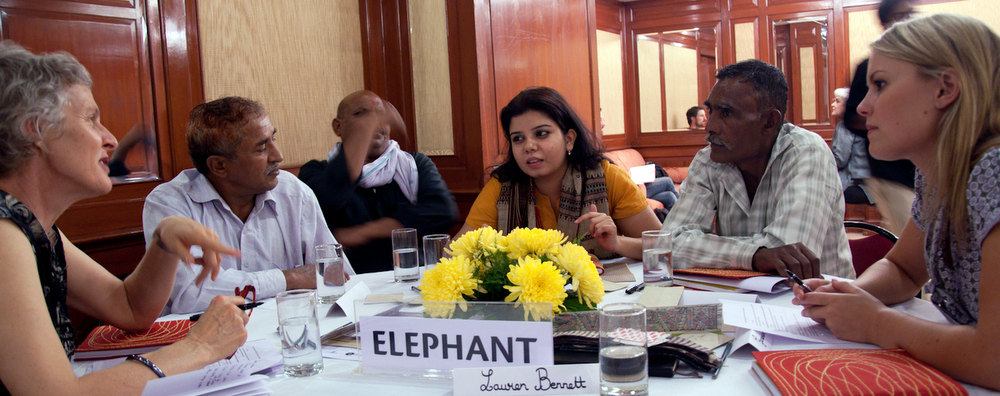
In Delhi last year, Sangam – the Australia India Design Platformhosted a roundtable and forum to share concepts and issues in global craft and design partnerships. There are many opportunities to link artisans to foreign markets through designers. What are new models for this transnational product development? What are the ethical issues and how might we resolve them?

Twenty-nine people looked through the draft standards for ethical labelling in craft products. This included a mix of Australians, Indians, designers, artisans, writers and managers. This group confirmed the standard that the information about producers should be included on the label, though in some cases it might be more appropriate to mention the village or family name, rather the individual artisan.

The most contentious issue was about transparency. Opinion was divided about whether designers should give artisans information about the pricing structure. While most agreed that this was good in principle, there were doubts about whether artisans would understand the kind of mark ups necessary to get product to the shops. This was left as a challenge to see how such information could be presented in a way that was easily understood by those without experience in retail.

Two elements were seen as important to the success of a code. The first is that it should not come at a cost to participants. It should be something that added overall value to the products. And second, that it should be open to verification. To keep costs down, this can be enabled by a system of consumer feedback.

Generally, it was felt that a code was important to increase the value of handmade products by offering consumers more reliable information about their origins.

Glimpses of the Roundtable:

One of the highlights of the Roundtable was an evocative talk by the venerable Indian craft writer Jasleen Dhamija, where she discussed the time-honoured tradition of innovation in Indian craft, and its close association with rites of passage.

For a full report on the Roundtable, go here.

Who made it? Draft standards for ethical labelling

The Harris Tweed label was tremendously successful in promoting textile crafts in the Scottish islands. There are parallel moves today in the use of geographical indications. But such labels do not include the names of those who wove the cloth. When would this be appropriate? What happens when the label is a designer brand, such as Prada? While it adds value to the product, how does it serve the longer term interests of the craftsperson?

A common issue in craft-design collaborations concerns the information that is carried with the product, particularly in the accompanying label. Brand development often seeks to minimise acknowledgement of sources in order to bolster market identity. This is sometimes at odds with the developmental aims, which are to promote the skills and culture of those involved in its production.

While most participants in craft development projects agree that the names of those craft skills contribute to the product should be included in the label, it is quite rare to find this. One reason is the absence of any standard that indicates what is a fair practice.

On 21 July, a roundtable of experts in craft, design and law met at RMIT University to develop a set of standards for ethical labelling. These standards provide the initial component of a broader code that aims to facilitate creative collaborations, particularly involving transnational partnerships.

The following draft standards are designed to provoke discussion. Their content will be considered at the mirror event in Delhi on 21 October this year.


Draft Standards for Best Practice in Labelling

  1. Labelling

    1. Consent

Information about the packaging and means of sale of the artefact should be shared between participants in product development.

    1. Attribution

All meaningful contributions to bringing an artefact into existence should receive recognition.

    1. Ingredients

The label should include relevant information about elements involved in production, such as natural materials, cultural traditions and specialist craft skills

    1. Verification

There should be a means of verifying the information on the label.


There are occasional comparisons with the film industry, where the titling convention allows for the acknowledgement of hundreds of persons involved in production, down to the boy who buys the coffee. Obviously, there are limits in the amount of information that can be included in a physical label. However, part of this discussion involves looking at expansive platforms, such as Facebook, that enable not only the transmission of more information, but also dialogue between producers and consumers.

Comments on these standards and labelling practice are welcome here.

The journey begins

Moe Chiba opening the Visible Hand forum

Moe Chiba opening the Visible Hand forum

Sangam – the Australia India Design Platform was launched in Melbourne on 21 July.  

During the day, RMIT Industrial Design hosted the Ethical Design Laboratory’s workshop into ethical labelling. Experts from around Australia met to develop a set of standards for creative collaborations. Representatives from law and design, alongside leading practitioners, considered best practice for labelling of transnational cultural products. These protocols contribute to the development of a Code of Practice for Creative Collaborations, supported by UNESCO. The results from Melbourne will be published on the website for discussion next month and then presented in Delhi at the mirror event on 21-22 October this year. 

In the evening, a panel considered what it means for an Australian designer to work in India today. The coordinator Kevin Murray opened the session with a reflection on the strength of Australian designers, coming from country whose experience of reconciliation grants a sensitivity to cultural difference. This included included video messages from four designers in India. The panel was led by Moe Chiba, the section head of culture for UNESCO New Delhi, who highlighted the role of designers in sustaining India’s cultural heritage, particularly in the crafts. Local textile designer Sara Thorn defied received wisdom about authenticity and argued for the virtue of artisans working with machines in India. Architect Chris Godsell reflected on his experience in building sports stadiums for the Delhi Commonwealth Games in 2010. While providing a cautionary tale about potential pitfalls, he spoke positively about the energy and capacity of Indian partners. Finally, Soumitri Varadarajan talked about the impact that design can have in India, focusing on the issue of maternal health. Afterwards, the panel was hosted at a network dinner at the City of Melbourne, including leading figures from the Indian community and government. (A recording of the forum is available here).

Overall, the evening generated a positive reflection on the opportunities for Australian designers working in India. But at the same time, there were some important questions posed that will remain challenges for the project:

From the Australian perspective, India has much to offer in terms of rich decorative traditions and expanding market. But what then from an Indian perspective might Australia have to offer in exchange? The answer for this question will unfold at the mirror forum in Delhi later this year.

In terms of developing standards for collaboration, there is much interest in focusing previous discussions towards a set of principles that can build confidence in product development partnerships between designers and craftspersons. The next challenge is to link those standards to the market, so that they can have direct economic benefits for those involved. This a matter for future workshops that will explore models of consumer engagement, particularly with social networks.

The journey began with a buoyant march, but steep mountains loom ahead.